{'OVERVIEW'}
My thesis focused on redesigning and implementing a 3D version of an already existing serious game for Photonics, originally built as an Augmented Reality experience.
Inspired by the original, the goal was to recreate the same mini-games/missions while delivering a distinctly different feel. This meant more than simply replicating what existed as it required a deep dive into the mechanics of the first game, understanding what worked, and thoughtfully altering them to suit a 3D environment.
A key part of the redesign process was identifying what would resonate with students in this new format. What elements would feel fresh, engaging, and worth experiencing in three dimensions. The result is a reimagined version of the original that stays true to its educational purpose while offering players a new and immersive way to explore the world of photonics.
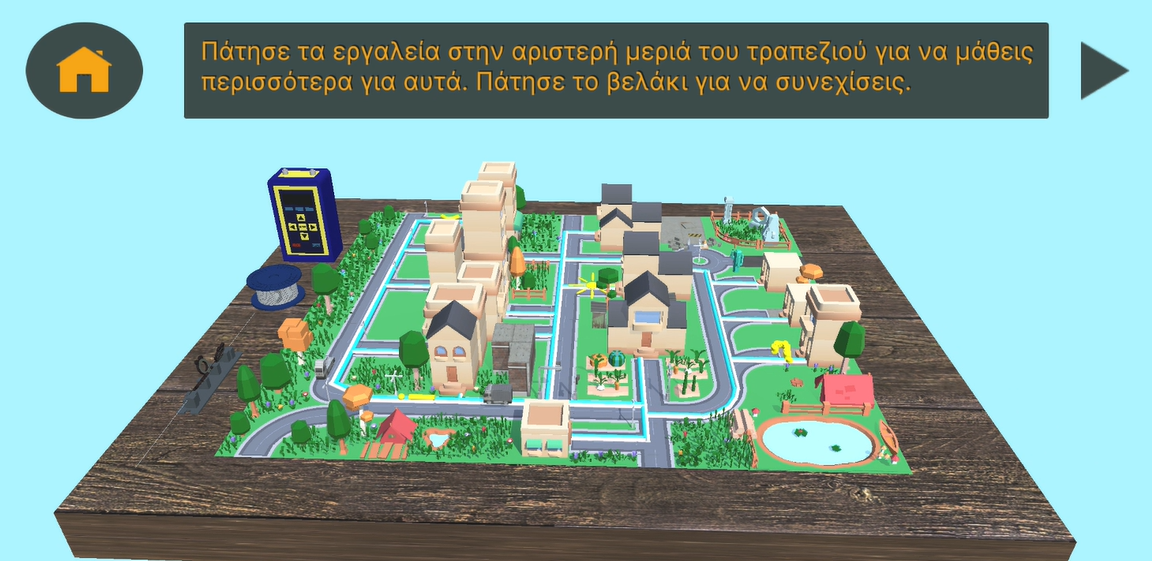
First Mission
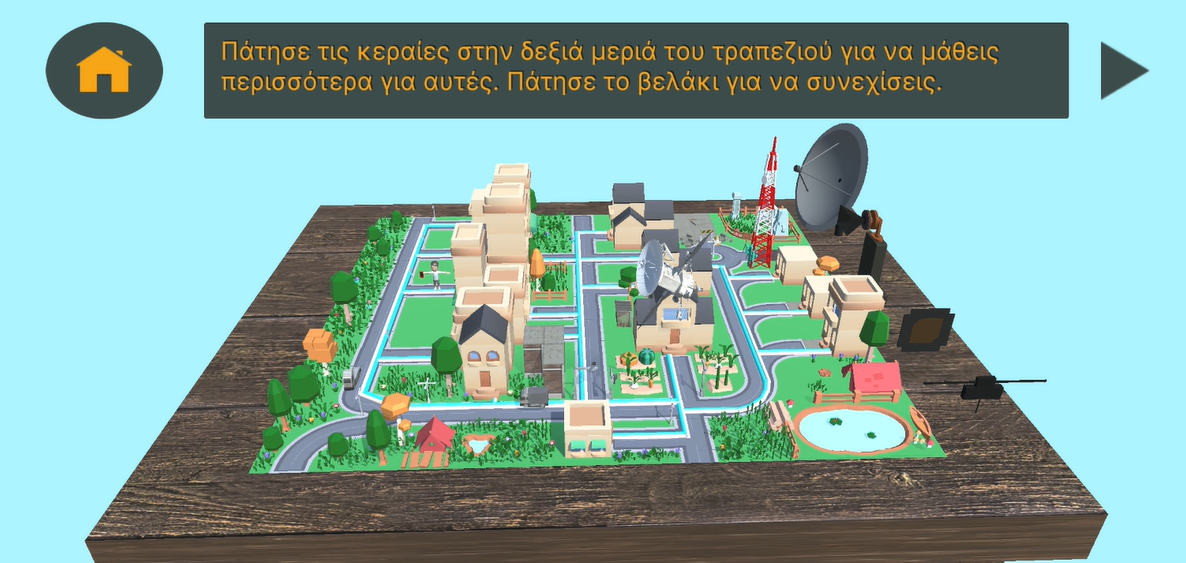
Second Mission
{'KEY FEATURES'}
MULTIPLE MINI-GAMES
Targets the gain of overall knowledge in the field
CLEAN CAMERA MOVEMENT
Package added for smooth camera movement for mobile
SERIOUS GAME DESIGN
Designed with both educational goals and player engagement in mind, balancing learning with fun
{'VIDEOS'}
In the first mini-game, the gameplay follows a structured flow designed to guide the player through the learning experience step by step:
- The player starts by reviewing information about various network tools, displayed on the left side of the table.
- Once ready, they advance to the gameplay phase by pressing the arrow in the top-right corner.
- The player must discover and interact with symbols spread across the map, including ?, Sun, X, and !.
- Upon selecting a symbol, the player is tasked with choosing the correct tool to measure the fiber network's power and assess whether an issue is present.
- If a problem is detected, the player must diagnose and apply the appropriate tool to resolve it.
- Once all symbols have been examined and the correct tools successfully applied, the mission is complete.
GAMEPLAY AND SCENE FOR MISSION 1
In the second mini-game, the gameplay follows a similar structured flow, this time challenging the player to explore and identify the real-world applications of various antenna types:
- The player begins by exploring information about various antenna types, displayed on the right side of the table.
- Once ready, they proceed to the gameplay phase by pressing the arrow in the top-right corner.
- The player must locate and interact with objects scattered across the map, including a person with a cellphone, a green truck, a satellite, and a telephone tower.
- Upon selecting an object, the game reveals its intended real-world use.
- The player is then challenged to match the object to the antenna that best suits its described function.
- Once all objects have been identified and correctly matched, the mission is complete.
GAMEPLAY AND SCENE FOR MISSION 2
{'CHALLENGES & SOLUTIONS'}
CHALLENGE: REPETITIVESS
With a single level layout and the symbols in the same place, repeated playthroughs could quickly feel monotonous and disengage the player.
SOLUTION: VARIATIONS OF THE LEVEL DESIGN
Multiple variations of the level design, focused particularly on the placement of the symbols, were created to provide diverse experiences and maintain player engagement.
CHALLENGE: DEVELOPMENT TIME CONSTRAINTS
Building two mini-games within a tight academic deadline posed a significant risk to development efficiency and overall polish.
SOLUTION: REUSABLE ASSETS AND CODE
Adopted a component reuse strategy, leveraging existing code architecture and scene setup from the first mini-game as a foundation for the second. This reduced redundant work and allowed me to focus remaining time on refining gameplay and content quality.
{'WHAT I LEARNED'}
Working on a serious game taught me how to strike a balance between education and entertainment as well as the importance of designing mechanics that promote critical thinking while keeping the player engaged.
On the technical side, this project pushed me to adopt efficient development practices within a tight timeline, most notably reusing code and structural setups across mini-games rather than rebuilding from scratch. It also introduced me to software design patterns such as the Singleton pattern, which helped me manage shared game systems efficiently and write cleaner, more maintainable code.
Through this project, I developed hands-on proficiency with Unity, an experience that proved invaluable for understanding the intricacies of 3D game development. Designing a full 3D environment from the ground up gave me a deeper appreciation for how visual variety and layout directly impact player engagement and experience.
Overall, this project was a comprehensive learning experience that enhanced both my technical skills and my understanding of game design principles, particularly in the context of educational games.
{'FUTURE IMPROVEMENTS'}
EXPANDED CONTENT & CUSTOMIZATION
More tools, antennas, and questions would broaden the game's educational scope. A settings menu could also let players personalize their environment, such as changing the background color or the table's appearance, to add a personal touch.
GAMIFICATION ELEMENTS
Adding points, badges, and progress indicators would give players a clearer sense of achievement. This would increase motivation and encourage continued engagement with the game.
ACCESSIBILITY FEATURES
A colorblind mode with adapted color schemes and options such as adjustable font sizes would make the game more inclusive. These additions would ensure a wider audience can comfortably enjoy the experience.